Terminalia Arjun

The Terminalia arjun, universally known in Pakistan as the Arjun Tree, is a majestic, deciduous tree that is deeply rooted in both the landscape and traditional medicine of the region. It is one of the most iconic “large” trees found along the canal banks of Lahore and in old gardens, prized for its cooling shade and distinctive “glowing” bark.

Description

  • The Bark: Its most striking feature is its smooth, grey-to-flesh-colored bark that peels off in large, thin flakes. This gives the trunk a clean, “bone-like” appearance that reflects sunlight.

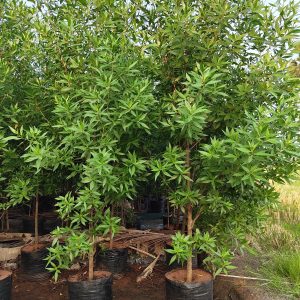
  • The Foliage: It has oblong, leathery green leaves that grow in pairs. The canopy is vast and spreading, often drooping slightly at the ends like a willow.

  • The Flowers & Fruit: In spring, it produces small, honey-scented, yellowish-white flowers. These turn into unique, woody, 5-winged fruits (looking like small starfruit) that fall to the ground in abundance.

  • Size: This is a giant. It can easily reach 60 to 80 feet in height with a massive trunk girth.

Key Benefits

  • Superior Shade: The Arjun provides a “thick” canopy that can lower the ground temperature beneath it by several degrees—a lifesaver during a Lahore June.

  • Cardiovascular Medicine: The bark is legendary in Ayurveda and local Unani medicine. It is a potent heart tonic used to strengthen heart muscles and manage blood pressure.

  • Soil Stabilizer: Because it has a deep and wide-reaching root system, it is excellent for preventing soil erosion, especially near water bodies or large plots.

  • Pollution Filter: It is a hardy “urban” tree that can withstand smoke and dust, making it an ideal choice for planting along busy roads or boundary walls of large industrial sites.

  • Wildlife Habitat: The tree is a favorite nesting spot for local birds and a host for the Antheraea paphia moth, which produces wild silk.

Maintenance & Care

  • Sunlight: Being a forest giant, it requires full, direct sun. It should never be planted in the shade of other trees or buildings.

  • Watering: While mature Arjun trees are quite drought-tolerant, they are “water-loving” by nature. They grow fastest and healthiest when planted near a water source (like a tube well, canal, or a naturally damp area). In the first 2–3 years, regular deep watering is essential.

  • Space Requirements: Do not plant this near a house foundation or a small boundary wall. Its roots are powerful and need significant space to expand. It is best suited for large lawns, farmhouses, or wide roadside verges.

  • Soil: It thrives in almost any soil but prefers the rich, alluvial “Bhal” (canal silt) found in our plains. It can even tolerate slightly alkaline or saline soil conditions.

  • Pruning: Generally, it requires very little pruning. You only need to remove the lower branches as it grows to clear a “walking path” beneath its canopy.
Category:

The Terminalia arjun, universally known in Pakistan as the Arjun Tree, is a majestic, deciduous tree that is deeply rooted in both the landscape and traditional medicine of the region. It is one of the most iconic “large” trees found along the canal banks of Lahore and in old gardens, prized for its cooling shade and distinctive “glowing” bark.

Description

  • The Bark: Its most striking feature is its smooth, grey-to-flesh-colored bark that peels off in large, thin flakes. This gives the trunk a clean, “bone-like” appearance that reflects sunlight.

  • The Foliage: It has oblong, leathery green leaves that grow in pairs. The canopy is vast and spreading, often drooping slightly at the ends like a willow.

  • The Flowers & Fruit: In spring, it produces small, honey-scented, yellowish-white flowers. These turn into unique, woody, 5-winged fruits (looking like small starfruit) that fall to the ground in abundance.

  • Size: This is a giant. It can easily reach 60 to 80 feet in height with a massive trunk girth.

Key Benefits

  • Superior Shade: The Arjun provides a “thick” canopy that can lower the ground temperature beneath it by several degrees—a lifesaver during a Lahore June.

  • Cardiovascular Medicine: The bark is legendary in Ayurveda and local Unani medicine. It is a potent heart tonic used to strengthen heart muscles and manage blood pressure.

  • Soil Stabilizer: Because it has a deep and wide-reaching root system, it is excellent for preventing soil erosion, especially near water bodies or large plots.

  • Pollution Filter: It is a hardy “urban” tree that can withstand smoke and dust, making it an ideal choice for planting along busy roads or boundary walls of large industrial sites.

  • Wildlife Habitat: The tree is a favorite nesting spot for local birds and a host for the Antheraea paphia moth, which produces wild silk.

Maintenance & Care

  • Sunlight: Being a forest giant, it requires full, direct sun. It should never be planted in the shade of other trees or buildings.

  • Watering: While mature Arjun trees are quite drought-tolerant, they are “water-loving” by nature. They grow fastest and healthiest when planted near a water source (like a tube well, canal, or a naturally damp area). In the first 2–3 years, regular deep watering is essential.

  • Space Requirements: Do not plant this near a house foundation or a small boundary wall. Its roots are powerful and need significant space to expand. It is best suited for large lawns, farmhouses, or wide roadside verges.

  • Soil: It thrives in almost any soil but prefers the rich, alluvial “Bhal” (canal silt) found in our plains. It can even tolerate slightly alkaline or saline soil conditions.

  • Pruning: Generally, it requires very little pruning. You only need to remove the lower branches as it grows to clear a “walking path” beneath its canopy.
Reviews

There are no reviews yet.

Be the first to review “Terminalia Arjun”

Your email address will not be published. Required fields are marked *

Scroll to Top