Jatropha

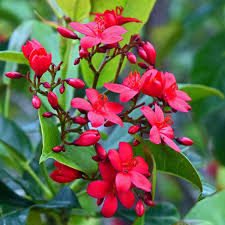
Jatropha (specifically Jatropha integerrima), commonly known as Peregrina or Spicy Jatropha, is a standout evergreen shrub that is becoming a staple in Lahore’s modern landscapes. It is beloved for being a “non-stop” bloomer, offering clusters of star-shaped flowers throughout the hottest months of the year.

As of May, while other plants might be taking a break from the heat, the Jatropha is usually just hitting its stride, showing off its vibrant colors against the intense Punjab sun.

Description

  • The Flowers: Small but brilliant, these five-petaled flowers grow in branched clusters. The most common color in Pakistan is a fiery scarlet red, though a soft pink variety is also occasionally available.

  • The Foliage: The leaves are particularly interesting; they are glossy, dark green, and can vary in shape even on the same plant—some are oval, while others have “fiddle-shaped” lobes.

  • Growth Habit: It is a versatile woody shrub. It can be kept as a compact bush (3–5 feet) or trained into a small, multi-trunked patio tree reaching up to 10–12 feet.

Key Benefits

  • Year-Round Blooming: In our climate, if the winter isn’t exceptionally harsh, Jatropha can produce flowers almost 365 days a year.

  • Butterfly Magnet: It is perhaps one of the best plants for attracting butterflies. If you sit near a Jatropha for ten minutes, you are almost guaranteed to see a variety of pollinators.

  • Exceptional Heat Tolerance: It thrives in the 40°C+ temperatures of May and June. In fact, the more sun it gets, the more flowers it produces.

  • Drought Resistant: Once established, it is very “water-wise.” It can handle periods of dryness much better than tropical plants like Hibiscus.

  • Pest Resistant: Because the plant contains a milky sap that is unpalatable to most insects, it rarely suffers from the pest problems that plague other flowering shrubs.

Maintenance & Care

  • Sunlight: Needs full sun. While it can grow in partial shade, the flowering will be much thinner and the plant will become “leggy.”

  • Watering: It prefers well-drained soil. In the current May heat, water it regularly, but ensure the pot or ground doesn’t stay waterlogged. It is better to let the soil dry out slightly between waterings than to over-saturate it.

  • Pruning: It responds very well to pruning. To keep it bushy, tip-prune the branches in late February. If it gets too tall, you can cut it back significantly, and it will flush out with new growth quickly.

  • Soil: It isn’t picky but thrives in the local “Bhal” (canal silt) mixed with a bit of organic compost.

  • Safety Note: Like many members of the Euphorbiaceae family, the sap and seeds are toxic if ingested. It is best planted where pets or small children won’t accidentally chew on it.

Category:

Jatropha (specifically Jatropha integerrima), commonly known as Peregrina or Spicy Jatropha, is a standout evergreen shrub that is becoming a staple in Lahore’s modern landscapes. It is beloved for being a “non-stop” bloomer, offering clusters of star-shaped flowers throughout the hottest months of the year.

As of May, while other plants might be taking a break from the heat, the Jatropha is usually just hitting its stride, showing off its vibrant colors against the intense Punjab sun.

Description

  • The Flowers: Small but brilliant, these five-petaled flowers grow in branched clusters. The most common color in Pakistan is a fiery scarlet red, though a soft pink variety is also occasionally available.

  • The Foliage: The leaves are particularly interesting; they are glossy, dark green, and can vary in shape even on the same plant—some are oval, while others have “fiddle-shaped” lobes.

  • Growth Habit: It is a versatile woody shrub. It can be kept as a compact bush (3–5 feet) or trained into a small, multi-trunked patio tree reaching up to 10–12 feet.

Key Benefits

  • Year-Round Blooming: In our climate, if the winter isn’t exceptionally harsh, Jatropha can produce flowers almost 365 days a year.

  • Butterfly Magnet: It is perhaps one of the best plants for attracting butterflies. If you sit near a Jatropha for ten minutes, you are almost guaranteed to see a variety of pollinators.

  • Exceptional Heat Tolerance: It thrives in the 40°C+ temperatures of May and June. In fact, the more sun it gets, the more flowers it produces.

  • Drought Resistant: Once established, it is very “water-wise.” It can handle periods of dryness much better than tropical plants like Hibiscus.

  • Pest Resistant: Because the plant contains a milky sap that is unpalatable to most insects, it rarely suffers from the pest problems that plague other flowering shrubs.

Maintenance & Care

  • Sunlight: Needs full sun. While it can grow in partial shade, the flowering will be much thinner and the plant will become “leggy.”

  • Watering: It prefers well-drained soil. In the current May heat, water it regularly, but ensure the pot or ground doesn’t stay waterlogged. It is better to let the soil dry out slightly between waterings than to over-saturate it.

  • Pruning: It responds very well to pruning. To keep it bushy, tip-prune the branches in late February. If it gets too tall, you can cut it back significantly, and it will flush out with new growth quickly.

  • Soil: It isn’t picky but thrives in the local “Bhal” (canal silt) mixed with a bit of organic compost.

  • Safety Note: Like many members of the Euphorbiaceae family, the sap and seeds are toxic if ingested. It is best planted where pets or small children won’t accidentally chew on it.

Reviews

There are no reviews yet.

Be the first to review “Jatropha”

Your email address will not be published. Required fields are marked *

Scroll to Top