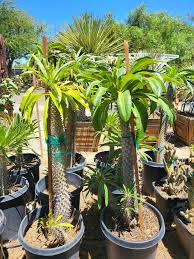
Madagascar Palm

The Madagascar Palm (scientifically known as Pachypodium lamerei) is a striking, sculptural plant that is often misunderstood. Despite its name and appearance, it is not a palm at all—it is actually a succulent closely related to the Adenium (Desert Rose). In Pakistan, it is a favorite for modern, minimalist landscapes and rooftop gardens because of its “alien-like” prehistoric look.

Quick Facts

  • Scientific Name: Pachypodium lamerei

  • Plant Type: Stem Succulent

  • Hardiness: Extremely heat-tolerant; loves the “Loo” winds and dry heat of the Punjab summer.

  • Appearance: Features a thick, silver-grey trunk covered in sharp spines, topped with a “crown” of long, leathery green leaves.

Key Benefits

  • Ultimate Low-Maintenance: This is a “set it and forget it” plant. Because it stores water in its thick, swollen trunk (caudex), it can survive for long periods without watering, making it ideal for busy homeowners or weekend gardeners.

  • Architectural Focal Point: Its unique, spiny trunk and tuft of leaves make it look like a piece of living art. It works perfectly in modern architectural settings, rock gardens, or as a standalone “specimen” in a decorative pot.

  • Fragrant Blooms: Once the plant matures (usually when it reaches 4–6 feet), it produces beautiful, large, white star-shaped flowers at the top. These flowers are highly fragrant and look very similar to Plumeria (Champa) blooms.

  • Pest Resistant: Thanks to its thorns and toxic sap, it is rarely bothered by local pests or wandering animals, making it a very “safe” investment for outdoor areas.

  • Sun-Proof: While many plants wilt in the 45°C Lahore heat, the Madagascar Palm actually thrives. The more sun it gets, the thicker and healthier its trunk becomes.

Care Tips for the Lahore Climate

  • Sunlight: Needs full, direct sun. It will become “stretched” and weak if kept in the shade. It is one of the best plants for south-facing balconies or open rooftops.

  • Watering: Treat it like a cactus. During the summer, water it deeply but only when the soil is completely dry. During the winter, stop watering almost entirely as the plant may go dormant and drop its leaves; overwatering in winter will cause the trunk to rot.

  • Soil: Requires “cactus mix” or very sandy soil. It must have excellent drainage. If planting in a pot, ensure there are multiple drainage holes.

  • Dormancy Note: Do not panic if it drops all its leaves in December or January. This is natural. New leaves will sprout from the top as soon as the weather warms up in February.

Landscape Styling Ideas

  • The “Desert Modern” Look: Pair Madagascar Palms with Agave, Adeniums, and decorative gravel or white pebbles. This creates a clean, high-end “Mexican” or “Desert” aesthetic.

  • Rooftop Accents: Because they are wind-resistant and love the sun, they are perfect for rooftop planters where other plants might get scorched or blown over.

  • The Entryway Guard: Place two large Madagascar Palms in tall, square planters on either side of a contemporary gate or glass door for a bold, structural statement.
Category:

The Madagascar Palm (scientifically known as Pachypodium lamerei) is a striking, sculptural plant that is often misunderstood. Despite its name and appearance, it is not a palm at all—it is actually a succulent closely related to the Adenium (Desert Rose). In Pakistan, it is a favorite for modern, minimalist landscapes and rooftop gardens because of its “alien-like” prehistoric look.

Quick Facts

  • Scientific Name: Pachypodium lamerei

  • Plant Type: Stem Succulent

  • Hardiness: Extremely heat-tolerant; loves the “Loo” winds and dry heat of the Punjab summer.

  • Appearance: Features a thick, silver-grey trunk covered in sharp spines, topped with a “crown” of long, leathery green leaves.

Key Benefits

  • Ultimate Low-Maintenance: This is a “set it and forget it” plant. Because it stores water in its thick, swollen trunk (caudex), it can survive for long periods without watering, making it ideal for busy homeowners or weekend gardeners.

  • Architectural Focal Point: Its unique, spiny trunk and tuft of leaves make it look like a piece of living art. It works perfectly in modern architectural settings, rock gardens, or as a standalone “specimen” in a decorative pot.

  • Fragrant Blooms: Once the plant matures (usually when it reaches 4–6 feet), it produces beautiful, large, white star-shaped flowers at the top. These flowers are highly fragrant and look very similar to Plumeria (Champa) blooms.

  • Pest Resistant: Thanks to its thorns and toxic sap, it is rarely bothered by local pests or wandering animals, making it a very “safe” investment for outdoor areas.

  • Sun-Proof: While many plants wilt in the 45°C Lahore heat, the Madagascar Palm actually thrives. The more sun it gets, the thicker and healthier its trunk becomes.

Care Tips for the Lahore Climate

  • Sunlight: Needs full, direct sun. It will become “stretched” and weak if kept in the shade. It is one of the best plants for south-facing balconies or open rooftops.

  • Watering: Treat it like a cactus. During the summer, water it deeply but only when the soil is completely dry. During the winter, stop watering almost entirely as the plant may go dormant and drop its leaves; overwatering in winter will cause the trunk to rot.

  • Soil: Requires “cactus mix” or very sandy soil. It must have excellent drainage. If planting in a pot, ensure there are multiple drainage holes.

  • Dormancy Note: Do not panic if it drops all its leaves in December or January. This is natural. New leaves will sprout from the top as soon as the weather warms up in February.

Landscape Styling Ideas

  • The “Desert Modern” Look: Pair Madagascar Palms with Agave, Adeniums, and decorative gravel or white pebbles. This creates a clean, high-end “Mexican” or “Desert” aesthetic.

  • Rooftop Accents: Because they are wind-resistant and love the sun, they are perfect for rooftop planters where other plants might get scorched or blown over.

  • The Entryway Guard: Place two large Madagascar Palms in tall, square planters on either side of a contemporary gate or glass door for a bold, structural statement.

Reviews

There are no reviews yet.

Be the first to review “Madagascar Palm”

Your email address will not be published. Required fields are marked *

Scroll to Top