Salvia Splendens

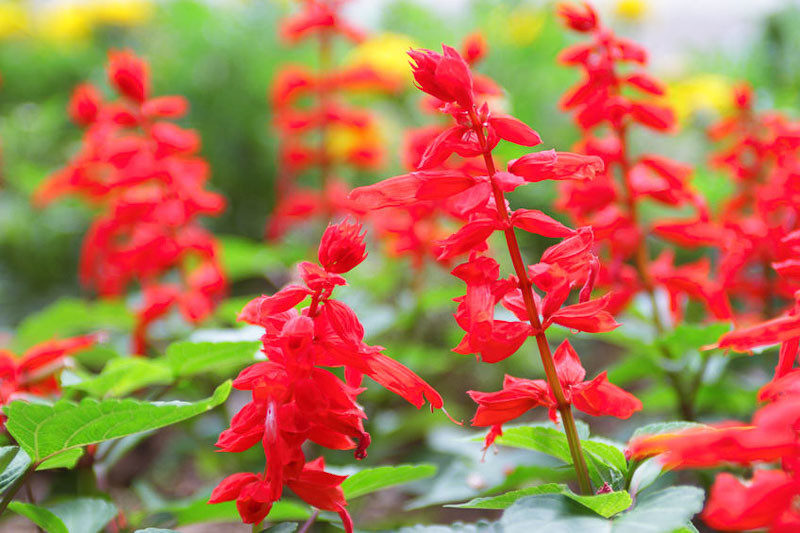
Salvia splendens, commonly known as the Scarlet Sage, is the “color bomb” of the Pakistani winter garden. While the aromatic herbs you’ve looked at (like Rosemary and Niazboo) are prized for their scent and utility, Salvia splendens is grown for its pure, high-voltage visual impact.

In Lahore and the surrounding plains, it is a quintessential winter annual that provides a dense carpet of color when the rest of the garden is cooling down.

Quick Facts

  • Scientific Name: Salvia splendens

  • Common Name: Scarlet Sage / Red Salvia

  • Plant Type: Tender Perennial (grown as a Winter Annual in Pakistan)

  • Key Feature: Upright spikes of tubular flowers sitting atop heart-shaped, dark green leaves.

Key Benefits

  • Intense Color Saturation: The classic variety is a brilliant, fiery red that is so bright it almost looks fluorescent. It is perfect for creating a “focal point” that can be seen from a distance.

  • Long Blooming Season: If planted in November/December, it will bloom continuously through the spring until the first true heatwaves of April.

  • Pollinator Magnet: The tubular flowers are highly attractive to butterflies and sunbirds, bringing movement and life to your garden.

  • Variety of Hues: While “Scarlet” is the most popular, local nurseries also stock varieties in purple, salmon, bicolor (red and white), and deep burgundy.

  • Compact Growth: Most modern varieties stay between 10–14 inches tall, making them ideal for neat, organized rows and borders.

Care Tips for the Local Climate

  • Timing: This is a cool-weather plant. In Lahore, it should be planted as saplings (Paneeri) in October or November. It will thrive through the foggy winter mornings and peak in beauty during February and March.

  • Sunlight: Prefers full sun to partial shade. During the mild winter sun, full exposure is best. As the sun gets stronger in March, a spot with afternoon shade will help the flowers last longer and prevent the colors from fading.

  • Watering: It has “soft” leaves, meaning it wilts quickly if it gets thirsty. Keep the soil consistently moist but not soggy.

  • Deadheading (Crucial): To keep the plant blooming, you must pinch off the spent flower spikes. Once a spike turns brown, cut it back to the next set of leaves. This signals the plant to produce 2 or 3 new flower spikes in its place.

Landscape Styling Ideas

  • The “Fire” Border: Plant a long, straight row of Red Salvia along a driveway or the edge of a lawn. The contrast of the scarlet flowers against the green grass is stunning.

  • The “Patriotic” Pot: Pair Red Salvia with white Petunias or Alyssum in a large container for a sharp red-and-white theme.

  • Mass Planting: For the best effect, don’t plant just one. Plant them in “drifts” of 10 or more. The collective impact of a mass of Salvia is much more powerful than a single plant.
Category:

Salvia splendens, commonly known as the Scarlet Sage, is the “color bomb” of the Pakistani winter garden. While the aromatic herbs you’ve looked at (like Rosemary and Niazboo) are prized for their scent and utility, Salvia splendens is grown for its pure, high-voltage visual impact.

In Lahore and the surrounding plains, it is a quintessential winter annual that provides a dense carpet of color when the rest of the garden is cooling down.

Quick Facts

  • Scientific Name: Salvia splendens

  • Common Name: Scarlet Sage / Red Salvia

  • Plant Type: Tender Perennial (grown as a Winter Annual in Pakistan)

  • Key Feature: Upright spikes of tubular flowers sitting atop heart-shaped, dark green leaves.

Key Benefits

  • Intense Color Saturation: The classic variety is a brilliant, fiery red that is so bright it almost looks fluorescent. It is perfect for creating a “focal point” that can be seen from a distance.

  • Long Blooming Season: If planted in November/December, it will bloom continuously through the spring until the first true heatwaves of April.

  • Pollinator Magnet: The tubular flowers are highly attractive to butterflies and sunbirds, bringing movement and life to your garden.

  • Variety of Hues: While “Scarlet” is the most popular, local nurseries also stock varieties in purple, salmon, bicolor (red and white), and deep burgundy.

  • Compact Growth: Most modern varieties stay between 10–14 inches tall, making them ideal for neat, organized rows and borders.

Care Tips for the Local Climate

  • Timing: This is a cool-weather plant. In Lahore, it should be planted as saplings (Paneeri) in October or November. It will thrive through the foggy winter mornings and peak in beauty during February and March.

  • Sunlight: Prefers full sun to partial shade. During the mild winter sun, full exposure is best. As the sun gets stronger in March, a spot with afternoon shade will help the flowers last longer and prevent the colors from fading.

  • Watering: It has “soft” leaves, meaning it wilts quickly if it gets thirsty. Keep the soil consistently moist but not soggy.

  • Deadheading (Crucial): To keep the plant blooming, you must pinch off the spent flower spikes. Once a spike turns brown, cut it back to the next set of leaves. This signals the plant to produce 2 or 3 new flower spikes in its place.

Landscape Styling Ideas

  • The “Fire” Border: Plant a long, straight row of Red Salvia along a driveway or the edge of a lawn. The contrast of the scarlet flowers against the green grass is stunning.

  • The “Patriotic” Pot: Pair Red Salvia with white Petunias or Alyssum in a large container for a sharp red-and-white theme.

  • Mass Planting: For the best effect, don’t plant just one. Plant them in “drifts” of 10 or more. The collective impact of a mass of Salvia is much more powerful than a single plant.
Reviews

There are no reviews yet.

Be the first to review “Salvia Splendens”

Your email address will not be published. Required fields are marked *

Scroll to Top