Thuja Tree

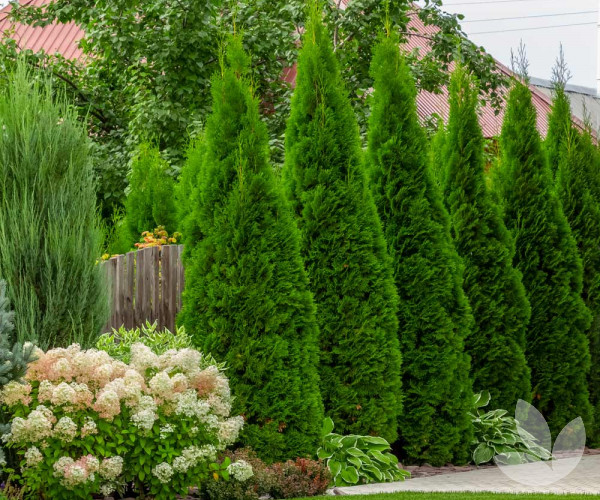
The Thuja Tree (scientifically Thuja occidentalis or Thuja orientalis), commonly known in Pakistan as the Morphankh or Paisa Plant, is perhaps the most popular coniferous evergreen in the country. Its local name, Morphankh (Peacock’s Fin), comes from the unique, flat, fan-like arrangement of its scale-like leaves.

In Lahore and the surrounding plains, it is the “go-to” plant for formal landscaping, boundary screening, and topiary art.

Description

  • The Foliage: Unlike pine trees with needles, Thuja has soft, flattened, scale-like leaves that overlap. They are typically a vibrant emerald green, though some varieties turn a slightly bronze hue in the peak of winter.

  • The Trunk: It usually has a straight, central trunk with reddish-brown, peeling bark.

  • Growth Habit: It naturally grows in a neat, conical (pyramid) shape. Left unpruned, it can reach 15 to 20 feet in our climate, but it is often kept much smaller through trimming.

  • The “Fruit”: It produces small, blue-green, waxy cones that eventually turn brown and woody.

Key Benefits

  • Natural “Green Wall”: Because it is dense and evergreen, it is the best plant for creating a privacy screen or a sound-absorbing hedge along boundary walls.

  • Low Maintenance: Once established, it is incredibly hardy. It doesn’t drop leaves (meaning no mess to clean on your lawn) and is very resistant to pests.

  • Drought & Heat Hardy: While it prefers consistent moisture, a mature Morphankh can handle the intense heat of a Lahore summer far better than most other conifers.

  • Formal Elegance: Its natural symmetry gives any garden an “ordered” and prestigious look. It is often used at the entrances of bungalows and offices.

  • Versatility: It grows equally well in large cement pots or directly in the ground.

Maintenance & Care

  • Sunlight: Thrives in full sun to partial shade. If it gets too much shade, the inner branches will become thin and “see-through.”

  • Watering: Young trees need regular watering to establish their roots. For mature trees, water deeply once the top few inches of soil feel dry. Avoid overwatering, as it can lead to root rot, which shows up as the entire tree turning brown from the bottom up.

  • Soil: It prefers well-drained soil. In our region, it does well in “Bhal” (canal silt) mixed with a bit of organic matter.

  • Pruning: The best time to prune is February or March. You can shear the sides to maintain a sharp “column” or “pyramid” shape.

    • Note: Never cut back into the “dead zone” (the brown, leafless interior of the branches), as new green growth will not sprout from old wood.

  • Browning Prevention: If you notice patches of brown in the center of the tree during May/June, it is often due to heat stress. A forceful wash with a hose in the evening helps remove dust and spider mites, which are common Thuja pests in dry weather.
Category:

The Thuja Tree (scientifically Thuja occidentalis or Thuja orientalis), commonly known in Pakistan as the Morphankh or Paisa Plant, is perhaps the most popular coniferous evergreen in the country. Its local name, Morphankh (Peacock’s Fin), comes from the unique, flat, fan-like arrangement of its scale-like leaves.

In Lahore and the surrounding plains, it is the “go-to” plant for formal landscaping, boundary screening, and topiary art.

Description

  • The Foliage: Unlike pine trees with needles, Thuja has soft, flattened, scale-like leaves that overlap. They are typically a vibrant emerald green, though some varieties turn a slightly bronze hue in the peak of winter.

  • The Trunk: It usually has a straight, central trunk with reddish-brown, peeling bark.

  • Growth Habit: It naturally grows in a neat, conical (pyramid) shape. Left unpruned, it can reach 15 to 20 feet in our climate, but it is often kept much smaller through trimming.

  • The “Fruit”: It produces small, blue-green, waxy cones that eventually turn brown and woody.

Key Benefits

  • Natural “Green Wall”: Because it is dense and evergreen, it is the best plant for creating a privacy screen or a sound-absorbing hedge along boundary walls.

  • Low Maintenance: Once established, it is incredibly hardy. It doesn’t drop leaves (meaning no mess to clean on your lawn) and is very resistant to pests.

  • Drought & Heat Hardy: While it prefers consistent moisture, a mature Morphankh can handle the intense heat of a Lahore summer far better than most other conifers.

  • Formal Elegance: Its natural symmetry gives any garden an “ordered” and prestigious look. It is often used at the entrances of bungalows and offices.

  • Versatility: It grows equally well in large cement pots or directly in the ground.

Maintenance & Care

  • Sunlight: Thrives in full sun to partial shade. If it gets too much shade, the inner branches will become thin and “see-through.”

  • Watering: Young trees need regular watering to establish their roots. For mature trees, water deeply once the top few inches of soil feel dry. Avoid overwatering, as it can lead to root rot, which shows up as the entire tree turning brown from the bottom up.

  • Soil: It prefers well-drained soil. In our region, it does well in “Bhal” (canal silt) mixed with a bit of organic matter.

  • Pruning: The best time to prune is February or March. You can shear the sides to maintain a sharp “column” or “pyramid” shape.

    • Note: Never cut back into the “dead zone” (the brown, leafless interior of the branches), as new green growth will not sprout from old wood.

  • Browning Prevention: If you notice patches of brown in the center of the tree during May/June, it is often due to heat stress. A forceful wash with a hose in the evening helps remove dust and spider mites, which are common Thuja pests in dry weather.
Reviews

There are no reviews yet.

Be the first to review “Thuja Tree”

Your email address will not be published. Required fields are marked *

Scroll to Top